
Are Electric Cars Ready for South Africa? A Practical Buyer’s Guide
Greg Cress explains how South African drivers can decide whether an electric car fits their home charging, daily routes, road trips, running costs, and ownership plans.
Originally published by Homes of Distinction. Adapted into an Electric One buyer guide from Greg Cress’s public conversation with Jonathan Broekman. View original source.

On this page
Quick answer
Yes, electric cars are ready for many South African drivers - but the better question is whether a particular EV is ready for your life.
The decision should not begin with the biggest battery or the fastest charging claim. Start with your daily distance, where the car sleeps, where you can charge, how often you drive long routes, and what you currently spend on energy. If those pieces fit, an EV can be remarkably convenient. If they do not, a hybrid or plug-in hybrid may be the more practical step today.
South Africa is not following a battery-electric-only path. In its July 2026 sales release, naamsa reported that new-energy vehicles represented 6% of domestic new light-vehicle sales for June, with traditional hybrids still the largest part of that category. That is useful context: buyers have more than one way to move toward electric mobility.
This guide is designed to help you choose deliberately rather than buy on hype or reject the technology because of old assumptions.
1. Choose the right kind of electrified vehicle
The terminology can make the market feel more complicated than it is. The main choices are:
- Hybrid electric vehicle (HEV): a petrol engine and small battery work together. You do not plug it in.
- Plug-in hybrid electric vehicle (PHEV): a larger battery can cover part of your driving on electricity, while a petrol engine remains available.
- Range-extender EV (REEV): the wheels are driven electrically, while a petrol engine acts primarily as a generator when needed.
- Battery electric vehicle (BEV): the car runs entirely on electricity and must be charged.
Your best fit depends on how you use the car. A driver with predictable daily travel and reliable home charging may find a BEV to be the simplest option. Someone who cannot charge where they park, or who regularly travels through areas with limited charging, may prefer a hybrid or plug-in hybrid while the network and their personal circumstances evolve.
Do not let the label decide for you. Let the use case decide.
2. Map a normal week before comparing cars
Before looking at claimed range, write down one ordinary week of driving:
- the round trip to work;
- school runs and shopping;
- regular client or family visits;
- your longest recurring weekday journey;
- and the long-distance routes you use several times a year.
Then compare those distances with the vehicle’s realistic range, not only its laboratory figure. WLTP range is a standardised comparison tool, not a promise for every route. Speed, weather, elevation, load, tyre choice and driving style all affect the result.
The objective is not to find a car that can complete your entire month on one charge. It is to find one that gives you a comfortable buffer between convenient charging opportunities.
3. Treat charging as parking with electricity
The biggest shift in EV ownership is not the drivetrain. It is the refuelling routine.
Petrol drivers usually wait until the tank is low and then make a dedicated stop. EV drivers can add energy while the car is already parked: at home, at work, at a shopping centre, at a hotel or during a road-trip break.
For most buyers, the first charging question should therefore be: where does the car spend the night?
If you have secure parking near a suitable electrical supply, ask a qualified installer to assess the property. A dedicated wallbox is convenient, but some drivers can recover their normal daily distance from a slower portable charger. The installation, circuit protection, earthing, cable route and available capacity must be checked for the specific property; a household plug should never be assumed safe merely because the connector fits.
Home solar is not essential, but it can improve the economics and give owners more control over when and how they charge. The useful habit is frequent, convenient top-ups rather than repeatedly running the battery close to empty.
4. Replace range anxiety with a route plan
Range anxiety is often strongest before someone has lived with an EV. Once drivers understand their car’s consumption and remaining-range estimate, the more practical concern becomes charger reliability and availability.
South Africa’s public network is still uneven, but it is expanding and being upgraded. GridCars announced a 2026 enhancement programme for selected charging sites and additional strategic locations. CHARGE now lists live off-grid hubs on the N3 and N12, with further corridor expansion in progress.
For a long trip, check more than the pin on a map:
- connector compatibility;
- advertised charging power;
- recent operational status;
- access hours and payment method;
- a backup charger within your remaining range;
- and what facilities are available during the stop.
A good EV route includes margin. It does not depend on arriving at a single charger with 1% remaining.
5. Calculate your own cost per kilometre
There is no honest single figure for what every EV costs to drive. The calculation depends on two numbers:
Cost per kilometre = (energy consumption in kWh/100 km × electricity price per kWh) ÷ 100
For example, a car using 16 kWh/100 km and energy costing R3.50/kWh would cost about R0.56/km for electricity:
(16 × R3.50) ÷ 100 = R0.56/km
That is an illustration, not a current tariff quote. Use the actual consumption of the vehicle and the actual price at the place where you charge.
In the Homes of Distinction conversation, I described two of my own tests. An efficient BYD Dolphin Surf reached roughly R0.42/km in a mixed test, while a larger Lexus RZ road trip came in at about R1.30/km. Those results are useful precisely because they are different. Vehicle efficiency and charging source matter.
When comparing an EV with petrol or diesel, use the same method and the same route assumptions. Also compare insurance, finance, tyre replacement, scheduled servicing, home-charger installation and the battery warranty - not energy alone.
6. Understand what fast-charging figures mean
Charging speed is a conversation between the charger and the car. A 350 kW charger does not force 350 kW into every vehicle, and a car’s advertised peak is not necessarily held for the whole session.
The basic relationship is:
Power = voltage × current
An 800V electrical architecture can deliver high power with less current than a 400V architecture at the same power level. That can reduce heat and help a suitable vehicle sustain faster charging. Volvo, for example, specifies an 800V system and an estimated 22-minute 10-80% charge on a 350 kW DC charger for the ES90, subject to conditions and specification.
For buyers, voltage is only one part of the story. Ask:
- what peak DC power the vehicle accepts;
- how long it holds useful power as the battery fills;
- whether the route has compatible chargers;
- how battery temperature affects the session;
- and how often you will actually need rapid charging.
A commuter who charges overnight may care more about efficiency and home-charging convenience than a headline DC peak.
7. Ask better questions about battery life
An EV battery does not normally work perfectly one day and become useless the next. Its usable capacity changes gradually, and the rate depends on battery chemistry, thermal management, climate, charging behaviour and how the vehicle is used.
The US Alternative Fuels Data Center says modern EV batteries are designed for extended life, while advising buyers to check model-specific warranty terms. Geotab’s 2026 analysis of more than 22,700 vehicles found an average annual degradation rate of 2.3%, but that fleet-level average is not a prediction for every car.
Before buying, obtain the actual warranty wording and ask:
- how many years and kilometres are covered;
- whether the warranty protects against capacity loss and at what threshold;
- how battery health is measured;
- whether the warranty transfers to a second owner;
- and what the inspection process is for a used EV.
For a used vehicle, a battery-health report and complete service history are more useful than a general claim that EV batteries either last forever or fail early.
8. Do not wait forever for the next generation
EV technology will keep improving. Ranges will rise, charging will become faster and software will add capabilities. That does not automatically make today’s vehicle a bad purchase.
The same rule applies as it does to phones and computers: buy when the current product solves a real need at a price you can justify. Do not pay for future capability you cannot use, but do not postpone a sensible decision indefinitely because a better model will always be coming.
Software updates can improve some vehicles after delivery, but support varies by manufacturer and model. Confirm what is available now. Treat promised future features as promises, not installed equipment.
Your EV-readiness checklist
You are in a strong position to consider a battery EV if most of these statements are true:
- I know my normal daily and weekly distances.
- I have safe, reliable charging where the car regularly parks.
- The vehicle’s realistic range gives me a comfortable buffer.
- I have checked my important long-distance routes and backup chargers.
- I have calculated costs using my electricity price and expected consumption.
- I understand the battery and vehicle warranty.
- I have compared the whole ownership cost, not just the fuel saving.
- I have test-driven the vehicle and can live with its controls, space and comfort.
If several answers are no, that does not mean electric mobility is irrelevant to you. It means you have identified the work to do - or a reason to consider a hybrid or plug-in hybrid instead.
The most useful next step is simple: map your week, calculate your costs and take an EV for a proper test drive. The right decision should become clearer once it is based on your life rather than somebody else’s assumptions.
Related video
Watch the source story


About the author
Greg Cress
Electric One host
Greg brings practical South African road-trip experience and automotive and eMobility context to Electric One's EV explainers.
Evidence
Sources and disclosure
Originally published by Homes of Distinction. Adapted into an Electric One buyer guide from Greg Cress’s public conversation with Jonathan Broekman.
Editorial note: Greg Cress approved this buyer-guide adaptation for publication on 22 August 2026. Running costs, charging times, range, and battery outcomes vary by vehicle, tariff, route, climate, and charging behaviour.
- Homes of Distinction: Are electric cars really ready for South Africa?
- naamsa July 2026 New Vehicle Sales Media Release
- GridCars national charging-network enhancement programme
- CHARGE off-grid charging hubs
- Volvo ES90 800V charging specifications
- US Alternative Fuels Data Center: EV battery life and buyer considerations
- Geotab 2026 EV battery-health analysis
Keep reading
Related Insights

The Lexus RZ’s Quiet Revolution
Clynton Yon speaks to Greg Cress about the Lexus RZ, EV ownership, charging habits, and why the transition to electric mobility can be easier than first-time drivers expect.
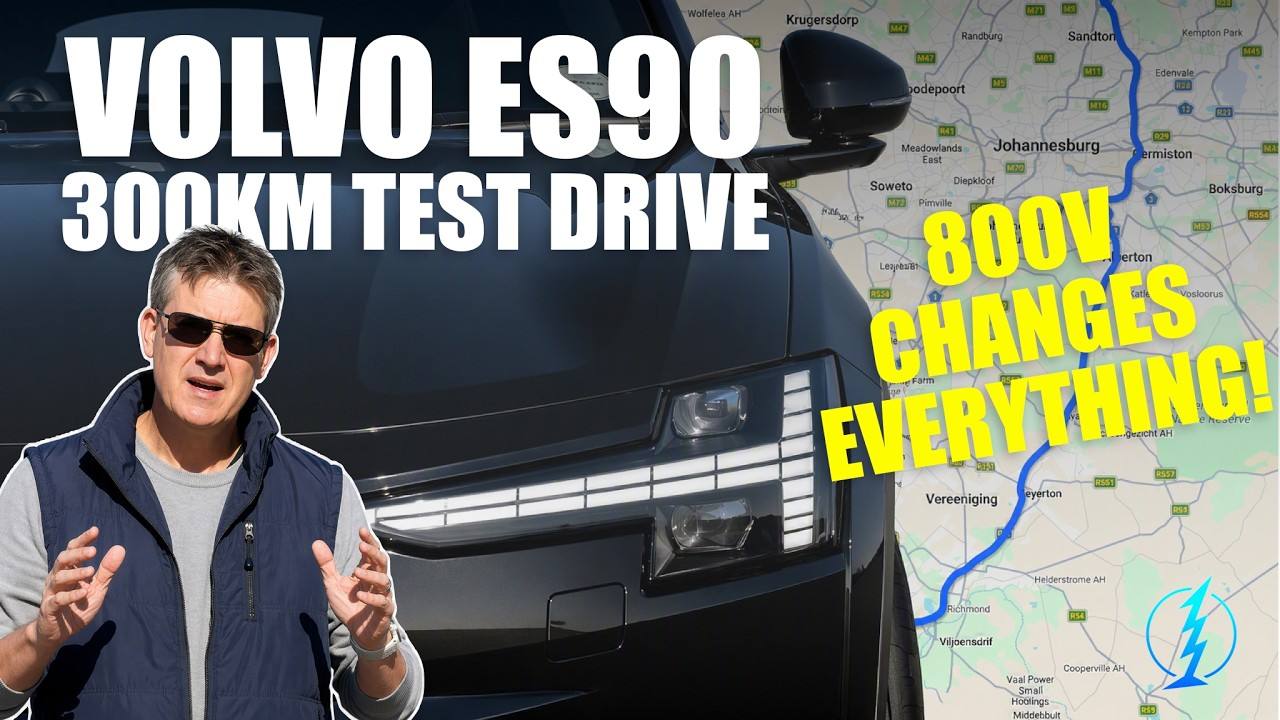
Why 800V Charging Matters for South African EV Drivers
Greg Cress explains the simple physics behind 800V EV charging, why it matters for the Volvo ES90, and why South African charging infrastructure is moving in this direction.
Continue the conversation
Ask Electric One a practical EV question.
Send a follow-up, correction, or topic idea for a future Insight.